Understanding the French Pharmacy Skincare Routine: Principles, Products, and Steps for Healthy Skin

Key Takeaways
A French pharmacy skincare routine is less about collecting products and more about choosing a few useful formulas that your skin can tolerate consistently.
- Start with your current skin condition, not just your usual skin type.
- Prioritize gentle cleansing, hydration, moisturization, and daily sunscreen.
- Introduce active ingredients slowly and change only one product at a time.
- Adjust textures and frequency as your climate, lifestyle, and skin needs change.
- Choose products thoughtfully by comparing ingredients, comfort, price, and practical fit.
- What defines the French pharmacy skincare routine
- How to assess your skin before building a routine
- The essential morning routine
- The essential evening routine
- Choosing French pharmacy skincare products
- How to introduce products safely
- Adapting the routine for changing needs
- Conclusion
- Frequently Asked Questions
- What is a French pharmacy skincare routine?
- How many steps should a French pharmacy skincare routine have?
- Is French pharmacy skincare suitable for sensitive skin?
- Should you cleanse your face in the morning?
- Can you use active ingredients every night?
- How long does it take to see results from a skincare routine?
- When should you see a dermatologist about a skincare problem?
What defines the French pharmacy skincare routine
Understanding the French Pharmacy Skincare Routine begins with a simple idea: healthy-looking skin is supported through regular, practical care rather than an overloaded shelf. The approach usually favors gentle formulas, a manageable number of steps, and products chosen for how they feel and function over time. You do not need to copy someone else’s exact routine to use the same principles. Instead, you can adapt them to your skin, budget, climate, and tolerance.
The focus on simple, effective formulas
A simple routine is easier to follow, but simplicity does not mean choosing products at random. You want each step to have a clear purpose, whether that is removing sunscreen, adding water to the skin, reducing moisture loss, or protecting against ultraviolet exposure. A cleanser, moisturizer, and sunscreen may be enough for one person, while another may benefit from a carefully selected treatment.
The practical test is whether a product earns its place in your routine. If a formula creates persistent discomfort, clashes with other products, or sits unused because it is inconvenient, it may not be the right choice even if it is popular. A smaller routine can also make it easier to identify what is helping and what is causing trouble.
Why barrier support comes before aggressive treatments
Your skin barrier helps limit water loss and provides a first line of defense against external irritants. When it is under stress, adding several strong treatments at once can make dryness, tightness, stinging, or visible redness more difficult to manage. Supporting the barrier first gives you a calmer starting point for deciding whether you need an exfoliant, retinoid, or another targeted ingredient.
This does not mean active ingredients are always unsuitable. It means you should introduce them when your skin is reasonably comfortable, use them at a measured frequency, and keep the rest of the routine uncomplicated. Comfort is useful information: skin that feels consistently tight or sore is asking you to reassess the routine rather than push harder.
How French pharmacy products differ from trend-driven skincare
French pharmacy skincare is often associated with formulas designed around everyday use, straightforward routines, and skin comfort. Trend-driven skincare, by contrast, can encourage frequent product changes because a new ingredient or technique is receiving attention. Neither label tells you whether a particular product will suit you, so the better question is whether the formula matches your needs and whether you can use it consistently.
You may find helpful background in this French pharmacy skincare guide, especially when you want to browse cleansers, moisturizers, treatments, or sunscreens in one place. Treat product descriptions as a starting point, then check the ingredient list, directions, size, and total cost before buying.
The role of consistency in long-term skin health
A routine works best when it fits naturally into your day. A basic morning routine that you follow most days is generally more useful than an elaborate sequence you abandon after a week. Give a product enough time to show whether it suits you, while still stopping sooner if you develop a clear adverse reaction.
Consistency also helps you make more accurate observations. Keep track of changes in dryness, oiliness, sensitivity, breakouts, and comfort instead of judging your skin from one morning to the next. If you enjoy comparing prices before committing, a practical beauty deals roundup can help you look for offers without letting a discount decide what your skin needs.
How to assess your skin before building a routine
Before you choose products, pause and observe your skin in its current state. Skin type describes tendencies such as oiliness or dryness, while skin concerns describe what is happening now, such as irritation, uneven tone, or breakouts. Your routine should account for both, along with the weather, your schedule, makeup habits, and how much time you realistically want to spend.

Identifying skin type versus current skin concerns
Skin type is not a permanent diagnosis. You may have naturally oily areas but temporary dehydration, or generally dry skin that becomes more reactive after over-cleansing. Notice how your skin feels a few hours after washing, where shine appears, whether makeup settles into dry areas, and whether your cheeks and forehead behave differently.
Then separate those observations from concerns you want to address. A blemish, dullness, or a rough patch may be temporary, while persistent sensitivity deserves a slower approach. Starting with one or two priorities keeps you from treating every visible change at once.
Recognizing signs of a compromised skin barrier
A stressed barrier may show up as tightness after cleansing, stinging when you apply familiar products, increased flaking, rough texture, or redness that seems out of proportion to your usual experience. These signs can have different causes, including weather, over-exfoliation, illness, or a new product, so they are clues rather than a diagnosis.
When your skin feels reactive, reduce the routine to gentle cleansing as needed, a bland moisturizer, and daytime sun protection. Avoid introducing several new products while you are trying to understand the change. If discomfort continues or becomes severe, professional advice is more useful than another online product recommendation.
Choosing products based on climate and lifestyle
A routine that feels comfortable in a humid summer may feel insufficient during a dry winter. Air conditioning, heating, wind, frequent travel, outdoor sports, and long workdays can all change how your skin responds. Texture matters here: a light lotion may be easier in heat, while a richer cream may be more comfortable in cold or dry conditions.
Your habits matter just as much. If you wear water-resistant sunscreen or makeup, your evening cleansing plan may need more attention. If you spend most of the day indoors, you may prefer fewer layers in the morning. A good routine is not a fixed ceremony; it is a set of choices that follows your actual life.
When sensitive skin needs a more cautious approach
Sensitive skin often benefits from a short ingredient list and a slower pace, but “natural,” “clean,” or “pharmacy” does not automatically mean irritation is impossible. Fragrance, essential oils, exfoliating acids, preservatives, and even otherwise useful actives can bother some people. Read the label and pay attention to your own history rather than relying on a category name.
If you have eczema, rosacea, recurring rashes, or unexplained inflammation, consider speaking with a dermatologist before experimenting with multiple treatments. You can still keep the daily routine simple while seeking guidance. The goal is not to avoid all change forever; it is to make changes in a way that gives your skin a fair chance to respond.
The essential morning routine
A morning routine can be brief and still cover the fundamentals. You want to remove overnight residue when needed, add enough moisture for comfort, and protect exposed skin from ultraviolet radiation. The exact number of products depends on how your skin feels and what you applied the night before.
Cleansing without stripping the skin
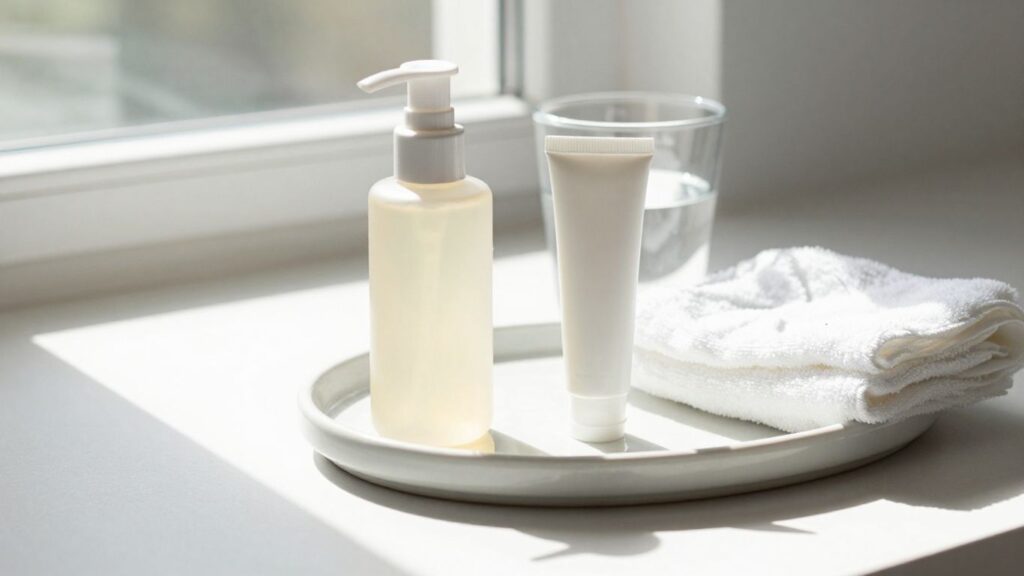
You may not need a strong morning cleanse, particularly if your skin is dry or easily irritated. A gentle cleanser, lukewarm water, or simply rinsing may be enough, depending on sweat, oil, and the products you used overnight. Avoid hot water and vigorous rubbing, both of which can leave skin feeling tighter.
If your face feels comfortable after rinsing, do not add extra cleansing just because a routine tells you to. If you wake up oily or used a heavy overnight product, choose a mild cleanser and rinse thoroughly. Your skin should feel clean but not squeaky or tight.
Adding hydration with lightweight layers
Hydrating products can make skin feel more comfortable, especially when indoor air is dry or your cleanser leaves you slightly parched. A watery serum, essence, or light lotion can be applied to damp or slightly damp skin if the formula suits you. You do not need several layers to achieve a hydrated feeling.
Start with one layer and allow it to settle before deciding whether you need more. Pilling often means you have applied too much, layered incompatible textures, or moved too quickly between steps. If hydration disappears within minutes, follow with moisturizer rather than endlessly adding watery products.
Using moisturizer to support the skin barrier
Moisturizer helps reduce water loss and improves comfort, though the best texture depends on your skin and environment. Look for a lotion, gel-cream, or richer cream according to how your skin feels. Apply enough to cover the face and neck without aggressive massage, especially if your skin is already sensitive.
A moisturizer can also make sunscreen easier to apply by reducing dry patches and uneven drag. If your sunscreen is moisturizing enough for you, you may be able to skip a separate morning cream. The right routine is the one that leaves your skin comfortable without feeling congested or overly layered.
Applying broad-spectrum sunscreen every day
Broad-spectrum sunscreen is the final morning step and should be applied to exposed areas, including the face, ears, neck, and other uncovered skin. Choose a product with a texture you are willing to use regularly, because comfort and convenience strongly affect consistency. Reapply according to the product directions and your exposure, particularly during extended outdoor time.
Sunscreen is not a substitute for shade, hats, or protective clothing. It is one part of a broader sun-protection plan. If a formula pills over your moisturizer, try using less of the layer beneath it, allowing more settling time, or changing the order and textures rather than rubbing repeatedly.
The essential evening routine
Evening care gives you a chance to remove the day’s sunscreen, makeup, sweat, and pollution before applying products intended to stay on the skin. It also tends to be the best time for treatments because you are not rushing toward daylight or makeup. Keep the sequence calm and avoid turning every night into a treatment night.
Removing makeup and sunscreen thoroughly
Begin by loosening makeup and sunscreen rather than scrubbing them away. Use a suitable first cleanser, cleansing balm, oil, or micellar product, then follow with a gentle water-based cleanser if your skin benefits from a second step. Pay attention to the hairline, jaw, sides of the nose, and around the eyes without tugging.
Thorough does not mean harsh. If your face feels hot, tight, or raw afterward, the process may be too aggressive or the products may not suit you. On nights when you have worn little beyond a light sunscreen, one well-chosen cleanser may be sufficient.
Deciding between micellar water and a traditional cleanser
Micellar water can be convenient when you are traveling, removing light makeup, or looking for a quick first step. If you use it, follow the label directions and rinse when recommended or when your skin feels coated. A traditional cleanser may be more practical when you need a fuller wash or prefer a water-based finish.
The choice is less about which method is universally best and more about what removes your products without discomfort. You might use micellar water first and cleanse afterward, or use one cleanser alone. Try not to keep rubbing because you feel compelled to achieve a perfectly bare sensation.
Applying targeted treatments at the right frequency
Treatments should address a specific concern and be introduced with restraint. Exfoliating acids, retinoids, benzoyl peroxide, and other active ingredients can be useful for some people, but more frequent application does not automatically produce faster improvement. Follow the product instructions and give your skin time to adjust.
A simple weekly plan can prevent accidental overuse:
- Use one active treatment on its designated nights rather than stacking several.
- Keep recovery nights focused on cleansing and moisturizing.
- Reduce frequency if you notice persistent dryness, burning, or peeling.
- Avoid adding another active until you understand how the first one feels.
This approach makes it easier to connect a reaction to a product. If an active ingredient is prescribed, follow your clinician’s instructions instead of replacing them with a general routine template.
Sealing in moisture with a nourishing cream
Finish with a moisturizer that leaves your skin comfortable through the night. A cream with a richer texture may help when the weather is cold, your barrier feels dry, or you use a treatment that causes mild dryness. Oily or combination skin may prefer a lighter lotion, particularly in warm weather.
You do not need a heavy layer to make the routine effective. Apply enough to cover the skin evenly, and use a smaller amount around areas that become congested if necessary. If you wake up greasy, adjust the texture or quantity rather than abandoning moisturizer altogether.
Choosing French pharmacy skincare products
Choosing French pharmacy skincare products does not require buying an entire collection at once. Start by defining the job you want a product to do, then compare formulas, directions, size, and price. If you shop online, Promo Deals gathers beauty offers and promotions in one destination, which can make it easier to spot a price drop while keeping your original needs in view.

Ingredients commonly used for hydration and comfort
Hydrating and comforting formulas may contain ingredients such as glycerin, hyaluronic acid, panthenol, squalane, ceramides, or occlusive agents. Their effects depend on the full formula and your skin, so an ingredient name alone does not guarantee a particular result. You are looking for a product that feels comfortable, layers well, and supports the rest of your routine.
If your skin is dry, a combination of humectants and emollient or occlusive ingredients may feel more satisfying than a watery product alone. If your skin is oily, you may prefer lightweight textures while still benefiting from hydration. Think in terms of feel and function, not a single fashionable ingredient.
Products for dry, sensitive, oily, and combination skin
Your skin type can help narrow the texture you explore, but it should not lock you into a rigid category. Dry skin may prefer richer creams, sensitive skin may need fewer potential irritants, oily skin may favor lighter layers, and combination skin may need different amounts on different areas.
Use this table as a starting point rather than a prescription:
| Skin tendency | Useful starting texture | What to watch for | Routine adjustment |
|---|---|---|---|
| Dry | Cream or balm | Tightness and flaking | Add richer moisture or reduce stripping cleansing |
| Sensitive | Simple lotion or cream | Stinging, redness, or itching | Introduce products slowly and avoid unnecessary actives |
| Oily | Light lotion or gel-cream | Congestion and excess shine | Use thin layers and avoid over-cleansing |
| Combination | Layered light products | Different needs across the face | Apply richer moisture only where needed |
The table is meant to help you compare starting points, not predict exactly how your skin will behave. Adjust one variable at a time, and remember that climate and current irritation can temporarily change your preferred texture.
How to evaluate fragrance, preservatives, and potential irritants
Fragrance is a personal consideration rather than an automatic sign that a formula is poor. Some people enjoy scented products without difficulty, while others develop irritation from fragrance components or essential oils. Preservatives also serve a practical purpose in many water-based formulas, so the question is whether the finished product suits your skin and is used according to its directions.
Read the ingredient list, especially if you already know which substances bother you. Patch testing can reduce uncertainty, though it cannot guarantee that a product will never react on your face. Stop using a product if you develop a significant or worsening reaction, and seek medical advice when symptoms are severe or persistent.
Balancing minimalist formulas with specific skin needs
Minimalism is useful when it prevents unnecessary layering, but it should not become a reason to ignore a clear need. You may need a dedicated treatment for acne, pigmentation, or persistent dryness, while another person may do best with only cleanser, moisturizer, and sunscreen. The routine should be as small as possible while still addressing your actual priorities.
When comparing products, consider more than the sale price. Look at the amount, frequency of use, shipping, return terms, and whether you already own something that performs the same role. A lower price is helpful only when the product fits your routine and will be used.
How to introduce products safely
A new product can be exciting, especially when you are trying to improve a specific concern. The safest approach is deliberately unexciting: introduce one change, observe your skin, and avoid making several decisions at once. This gives you clearer information and limits the scale of a potential reaction.
Adding one new product at a time
Add one product and keep the rest of your routine stable for several days or longer, depending on the product and your skin. If you change a cleanser, serum, moisturizer, and sunscreen together, it becomes difficult to identify the cause of irritation or improvement. Write down the date you started and where you used the product if that helps you remember.
Begin with the product that addresses your most practical priority. There is little value in adding a decorative extra when your skin is currently uncomfortable. Once you know a formula works for you, you can decide whether another addition is genuinely necessary.
Patch testing before applying products widely
Patch testing can be done by applying a small amount to an inconspicuous area, such as the inner arm or a limited area near the jaw, while following the product instructions. Observe for immediate discomfort and delayed changes over the period recommended for the formula. Face skin may still respond differently, so patch testing is a precaution rather than a guarantee.
Do not patch test several new products at the same time. If you experience swelling, intense burning, blistering, breathing difficulty, or a rapidly spreading rash, stop using the product and seek prompt medical care rather than waiting for the test period to finish.
Adjusting frequency for exfoliants and active ingredients
Many active products are easier to tolerate when used less often at first. Start with the directions, or with a lower frequency when the label permits and your skin is known to be reactive. Avoid combining multiple exfoliants or strong treatments until you understand the first product’s effects.
A mild tingle is not a requirement for effectiveness. Burning, persistent redness, cracking, and painful peeling are reasons to pause and reassess. Use a gentle cleanser and moisturizer during recovery, then ask a dermatologist or pharmacist for advice if the problem does not settle.
Knowing whether a reaction is irritation or purging
Irritation can involve burning, itching, diffuse redness, tightness, or peeling and may appear wherever the product was applied. “Purging” is a narrower idea sometimes associated with certain actives that speed cell turnover, but it should not be used to dismiss every worsening reaction. A new rash, swelling, or discomfort is not something you need to endure in hopes that the product will eventually work.
Stop and evaluate the product, frequency, and surrounding routine. If the change is severe, persistent, or difficult to interpret, professional assessment is safer than guessing. Your skin does not need to look worse before a routine can be considered successful.
Adapting the routine for changing needs
Your skin is affected by more than the products in your cabinet. Seasons, travel, stress, illness, medication, sleep, and environmental exposure can all alter comfort and oil production. A flexible routine lets you respond without replacing everything whenever conditions change.
Modifying skincare across seasons
In cold or dry weather, you may need a richer moisturizer, gentler cleansing, or fewer exfoliating nights. In hot and humid weather, lighter layers may feel better, but you should not skip moisturizer if your skin still needs it. Sweat and increased sunscreen use may also make evening cleansing more important.
Change texture before changing the entire philosophy. A lotion can become a cream, or a daily active can become an occasional one. Seasonal adjustments should make the routine more comfortable, not more complicated.
Adjusting products during travel or environmental stress
Travel often combines dry airplane air, unfamiliar water, temperature changes, disrupted sleep, and extra sunscreen. Pack a short routine in secure, clearly labeled containers and avoid testing several new products while away from home. Familiar formulas are usually more practical than ambitious travel experiments.
If your skin feels dry during a trip, focus on cleansing gently, moisturizing, and protecting it from the sun. If you are exposed to heat, wind, or pollution, rinse or cleanse appropriately without scrubbing. Once you return, give your skin a few days to settle before deciding that your whole routine has failed.
Simplifying the routine during flare-ups
During a flare-up, remove optional steps first. Pause exfoliants, strong treatments, fragranced extras, and recently introduced products while keeping only the basics your skin tolerates. Use lukewarm water, apply moisturizer gently, and avoid picking or rubbing affected areas.
Simplicity can make the next decision clearer. If the flare-up improves, reintroduce products one by one only when necessary. If it does not improve, or if you have pain, swelling, oozing, or rapidly spreading redness, seek medical care rather than continuing to experiment.
Understanding when to consult a dermatologist
A dermatologist can help when acne, rosacea, eczema, unusual dryness, persistent redness, or pigmentation does not improve with gentle care. You should also consider professional advice when a reaction is painful, recurrent, widespread, or interfering with sleep and daily life. Product reviews cannot replace an examination or medical history.
Bring a list or photographs of the products you use, including treatments and sunscreen, and note when symptoms began. This information can make the appointment more useful. A professional may recommend a simpler routine, a specific treatment, or testing for an underlying issue.
Conclusion
A French pharmacy skincare routine is best understood as a practical framework: cleanse gently, hydrate and moisturize according to your needs, protect your skin during the day, and introduce treatments with patience. When you assess your skin honestly and adjust for climate, lifestyle, and sensitivity, you can build a routine that is effective without becoming excessive.
Frequently Asked Questions
What is a French pharmacy skincare routine?
It is a simple, consistent approach centered on practical products for cleansing, hydration, moisturization, treatment when needed, and daily sun protection. The routine is adapted to your skin rather than copied exactly from another person.
How many steps should a French pharmacy skincare routine have?
There is no required number. Many people can cover their basic needs with three or four steps, while others may add a targeted treatment. Start with the fewest products that address your actual concerns.
Is French pharmacy skincare suitable for sensitive skin?
It can be, but no category guarantees that every formula will suit sensitive skin. Read the ingredient list, patch test when appropriate, introduce products slowly, and stop using anything that causes significant discomfort.
Should you cleanse your face in the morning?
It depends on your skin and what you used overnight. Rinsing may be enough for some dry or sensitive skin, while a gentle cleanser may help if you wake up oily or sweaty.
Can you use active ingredients every night?
Not necessarily. Frequency should follow the product directions and your skin’s tolerance. Start cautiously, avoid stacking several strong actives, and reduce use if dryness, burning, or persistent redness develops.
How long does it take to see results from a skincare routine?
Some products can improve comfort quickly, while concerns such as acne, uneven tone, or texture often take longer. Keep the routine stable long enough to assess it, unless you experience a clear adverse reaction.
When should you see a dermatologist about a skincare problem?
Seek professional advice for persistent or worsening symptoms, painful or widespread reactions, recurring rashes, significant acne, or concerns that do not improve with gentle care. Urgent symptoms such as facial swelling or breathing difficulty need prompt medical attention.