

Key Takeaways
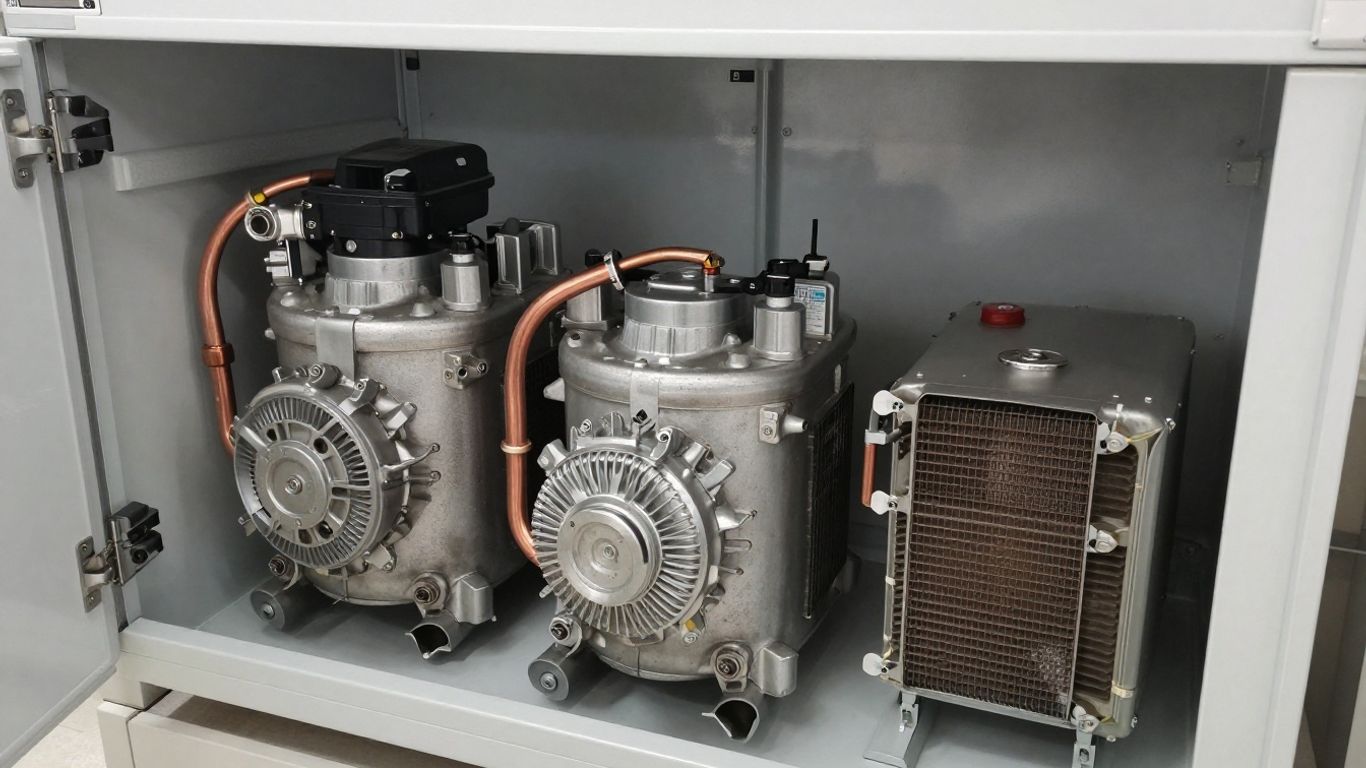
Refrigerator compressors differ in their compression method, enclosure, drive system, and ideal workload. Understanding those differences helps you compare cooling performance, energy use, noise, serviceability, and long-term cost.
- Reciprocating compressors use pistons and remain common in household and smaller commercial refrigerators.
- Rotary and scroll designs can offer compact operation, smooth refrigerant flow, and lower vibration.
- Screw and centrifugal compressors are generally better suited to larger, continuous refrigeration loads.
- Hermetic, semi-hermetic, and open-drive construction determines how easily a compressor can be serviced.
- The right choice depends on capacity, refrigerant compatibility, climate, noise, space, and ownership costs.
- How refrigerator compressors work
- Reciprocating compressors
- Rotary and scroll compressors
- Screw and centrifugal compressors
- Compressor construction and drive types
- How to choose the right refrigerator compressor
- Compressor problems, maintenance, and replacement
- Conclusion
- Frequently Asked Questions
- What is the main job of a refrigerator compressor?
- Which compressor type is common in household refrigerators?
- Are scroll compressors better than reciprocating compressors?
- What does hermetic compressor mean?
- Why do compressors get hot?
- Can a larger compressor cool a refrigerator faster?
- When should you replace a refrigerator instead of its compressor?
How refrigerator compressors work
A refrigerator compressor is the part that moves refrigerant through the sealed refrigeration circuit. It draws in low-pressure vapor from the evaporator, compresses it, and sends hotter, high-pressure vapor toward the condenser. Once you understand that basic job, the differences among the many types of refrigerator compressors become easier to follow.
The compressor’s role in the refrigeration cycle
The refrigeration cycle begins as refrigerant absorbs heat inside the cabinet or refrigerated space. The compressor receives that low-pressure vapor and provides the force needed to keep it circulating. After compression, the refrigerant travels to the condenser, where it releases heat before returning through the expansion device and evaporator.
The compressor does not create cold directly. Instead, it maintains the pressure difference that allows the refrigerant to evaporate at a low temperature and condense at a higher one. This distinction helps you diagnose problems: a refrigerator can have a working fan and thermostat yet still fail to cool if the compressor cannot circulate refrigerant properly.
How pressure and temperature change during compression
When the compressor squeezes refrigerant vapor into a smaller space, its pressure rises. Its temperature rises as well, which is why the discharge line near a running compressor may feel hot. The high-pressure vapor then gives up heat in the condenser before the cycle starts again.
The exact pressure and temperature depend on the refrigerant, operating conditions, load, and compressor design. A technician therefore checks measured system conditions rather than judging performance from cabinet temperature alone. Excessive discharge heat can point to poor airflow, an incorrect charge, high ambient temperature, or internal compressor trouble.
Displacement, capacity, and cooling performance
Displacement describes how much refrigerant vapor a compressor can move during each cycle or revolution. Capacity is the useful cooling output available under specified conditions, and it depends on more than motor size. Suction and discharge pressures, refrigerant choice, speed, efficiency, and ambient temperature all affect the result.
A compressor that is too small may run for long periods without reaching the set temperature. One that is too large may start and stop frequently, creating unnecessary stress and uneven temperatures. You should compare rated capacity at conditions close to the refrigerator’s actual operating environment.
Why compressor efficiency affects energy use
The compressor often accounts for a substantial share of a refrigerator’s electricity use because it works against a pressure difference every time it runs. Efficient valves, bearings, motors, and compression chambers can reduce the work needed to deliver a given cooling output. Good condenser airflow matters too, since a dirty or crowded condenser raises the pressure the compressor must overcome.
Efficiency is not a single number detached from usage. A model that performs well at one load or ambient temperature may not be the best match elsewhere. For broader background on compressor principles, you can also read this refrigeration compressor guide, then compare the operating conditions listed on actual product specifications.
Reciprocating compressors
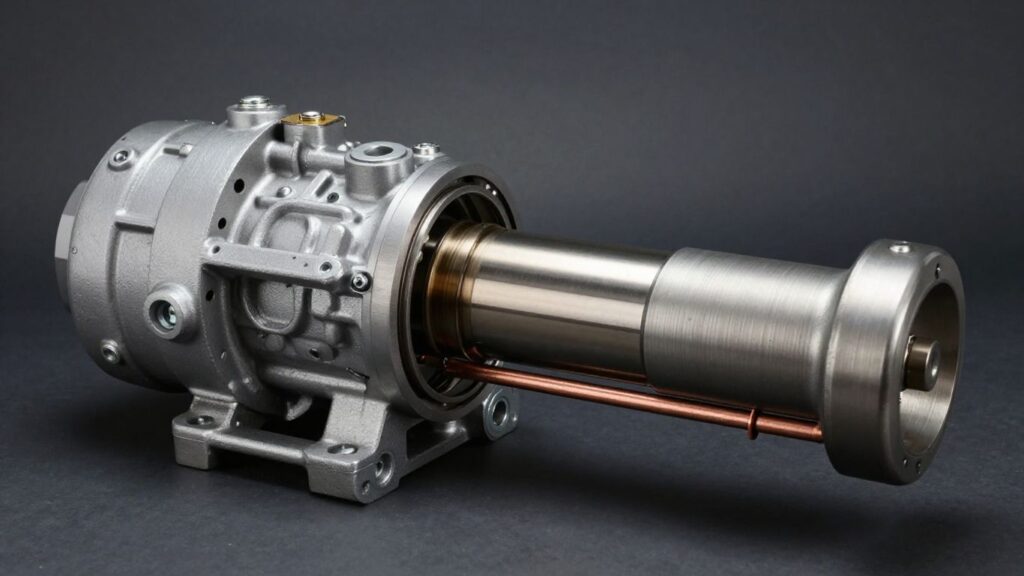
Reciprocating compressors use a piston moving inside a cylinder to draw in, compress, and discharge refrigerant vapor. They are among the most familiar designs because they can cover a wide range of small and medium refrigeration duties. Their mechanical layout is easy to understand, but the moving parts also create vibration and wear that must be considered.
How piston compressors operate
A motor turns a crankshaft, which moves the piston back and forth through a connecting rod. During the suction stroke, an inlet valve allows low-pressure vapor into the cylinder. During the compression stroke, the inlet closes and the discharge valve opens when the vapor reaches a higher pressure.
Each cylinder produces a series of pulses rather than a perfectly continuous flow. Multiple cylinders, carefully designed valves, and suitable mounts can smooth those pulses. Oil circulation lubricates the moving parts in many designs, while the motor and crankcase must remain compatible with the refrigerant and lubricant used.
Hermetic, semi-hermetic, and open designs
A reciprocating mechanism can be placed inside different types of housings. In a hermetic compressor, the motor and compressor are sealed inside a welded shell. A semi-hermetic model uses a bolted housing that can be opened for service, while an open compressor has a shaft extending outside the housing to connect to a separate motor.
These categories describe construction rather than compression method. You can therefore find reciprocating compressors in hermetic, semi-hermetic, and open-drive forms. The enclosure affects leakage risk, service access, installation work, and the consequences of a motor or internal mechanical failure.
Advantages for household and commercial refrigerators
Piston compressors are practical when you need a proven design, flexible capacity range, and relatively straightforward controls. They can work well in domestic refrigerators, display cases, freezers, and other systems where the load varies but remains within the compressor’s rated envelope.
They are also familiar to service technicians, which can make diagnosis easier. For a household appliance, a sealed reciprocating compressor may be selected as part of the complete refrigerator rather than purchased as an independently sized component. In commercial equipment, the ability to specify different capacity and enclosure combinations can be more valuable.
Common limitations and failure points
The piston, connecting rod, crankshaft, and valves all contribute to mechanical complexity. Wear can reduce volumetric efficiency, while damaged valves may cause poor pumping even when the motor still runs. Vibration can increase if mounts soften, tubing contacts the cabinet, or internal parts become unbalanced.
Common symptoms include a repeated clicking sound, a hot shell, tripped overload protection, or a motor that hums without starting. Those symptoms can also come from a relay, capacitor, wiring fault, restricted airflow, or excessive system pressure, so replacing the compressor immediately is not always justified.
Rotary and scroll compressors
Rotary and scroll compressors replace the back-and-forth piston motion with rotating or orbiting compression elements. Their compact layouts can reduce vibration and support smooth refrigerant flow, although each design has its own limits. You will often see these compressors discussed in smaller appliances, air-conditioning equipment, and selected commercial systems.
How rotary compressors create refrigerant flow
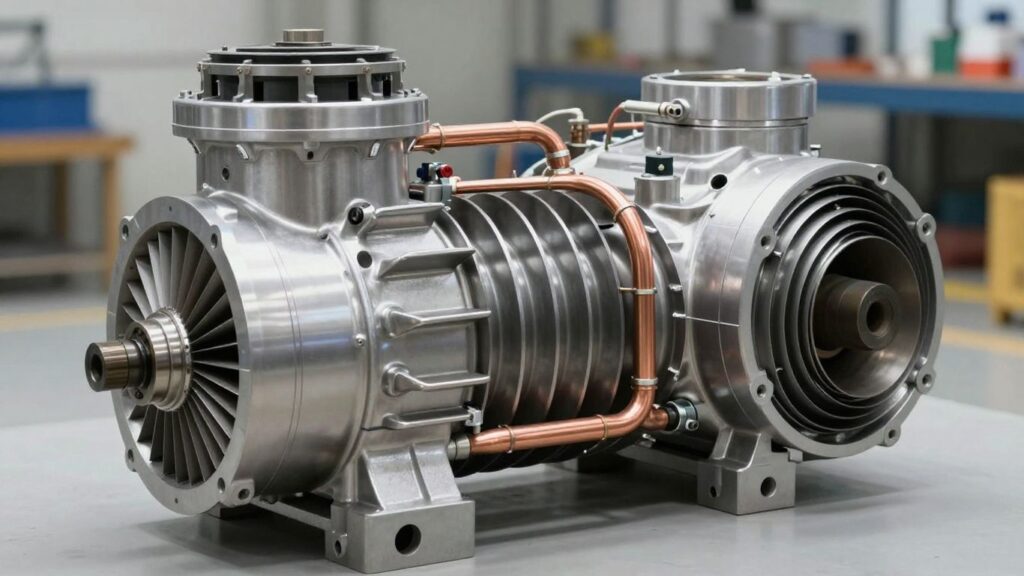
A rotary compressor uses a rotating element inside a cylinder to trap and compress refrigerant vapor. Depending on the design, a rolling piston, vane, or other rotor divides the chamber into changing volumes. As the chamber becomes smaller, pressure rises and the compressed vapor moves toward the discharge side.
Because the compression action is rotary, the package can be compact. Clearances, lubrication, and sealing are critical, however. A small loss of sealing performance can reduce capacity, and liquid refrigerant entering the compression space can cause serious mechanical damage.
Where rotary compressors are used
Rotary compressors are often considered when limited space, modest capacity, and relatively smooth operation matter. They can suit household refrigerators and other small refrigeration equipment, while related rotary designs are also used in air-conditioning applications.
Their usefulness depends on the required pressure ratio and duty cycle. A compact compressor is not automatically the right choice for a large cold room or a system with highly variable loads. You should check the manufacturer’s application range rather than choosing solely by physical size.
How scroll compressors differ from piston designs
A scroll compressor uses two spiral-shaped elements. One remains fixed while the other orbits, creating pockets of refrigerant that move inward and become smaller. The discharge usually occurs near the center, producing a more continuous flow than the separate strokes of a single piston.
With fewer reciprocating parts, a scroll design can have low torque variation and smooth operation. It still needs accurate clearances, proper lubrication, and protection from liquid floodback. Its sealed construction and application range must also be considered before you treat it as a direct substitute for a piston compressor.
Efficiency, noise, and reliability considerations
Rotary and scroll designs may be quiet and efficient when correctly matched to the system. Their smoother motion can reduce vibration, which is useful in homes, offices, and other spaces where sound matters. Efficiency can fall quickly if the compressor is oversized, operated outside its envelope, or exposed to poor condenser airflow.
Reliability depends on clean refrigerant, suitable oil return, correct electrical protection, and stable operating pressures. A design with fewer moving parts is not maintenance-free. You still need to protect it from overheating, liquid carryover, blocked airflow, and repeated abnormal starts.
Screw and centrifugal compressors
Screw and centrifugal compressors are usually associated with larger refrigeration systems rather than standard household refrigerators. Screw compressors use intermeshing rotors, while centrifugal compressors add energy to refrigerant with a high-speed impeller. Both can move substantial refrigerant flow, but they require system conditions that are uncommon in a kitchen appliance.
How screw compressors handle continuous refrigeration loads
A screw compressor traps refrigerant vapor between rotating male and female rotors. As the rotors turn, the trapped volume decreases and the vapor moves toward the discharge port. This creates a relatively continuous compression process, unlike the individual strokes of a reciprocating compressor.
Many screw systems use capacity control to adjust output as the load changes. Oil management, rotor clearances, bearings, and discharge temperature all require careful engineering. When properly selected, the design can operate for long periods without the repeated start-stop pattern that smaller systems may experience.
When screw compressors suit large cold-storage systems
Screw compressors make sense when a facility has a sustained refrigeration demand, multiple evaporators, or a large cold-storage load. They can be integrated into industrial systems where operators monitor pressures, oil condition, temperatures, and capacity controls as part of routine operation.
Their size, installation requirements, and service needs usually make them excessive for a domestic refrigerator. A smaller positive-displacement compressor can provide the required capacity with simpler controls and lower initial complexity. The right decision comes from the load profile, not from choosing the most powerful design.
How centrifugal compressors use high-speed impellers
A centrifugal compressor accelerates refrigerant vapor through a rapidly rotating impeller. The impeller adds velocity, and stationary passages then convert part of that velocity into pressure. The result is a dynamic compression process rather than the fixed-volume trapping used by piston and screw mechanisms.
Centrifugal units can be effective at high flow rates when operating conditions remain within their stable range. Their performance is sensitive to speed, pressure ratio, and system load. Surge protection and precise controls are important because operation far from the intended point can cause unstable flow.
Why these designs are uncommon in household refrigerators
Household refrigerators need a small, economical compressor that can tolerate frequent cycling, fit in a tight space, and operate quietly with simple controls. Screw and centrifugal systems generally need larger flows, more elaborate controls, and more specialized service support than that setting justifies.
That does not make them better or worse in general. It means their strengths appear in a different context. For a home appliance, compact reciprocating, rotary, or scroll designs are usually more practical, while industrial facilities may benefit from the continuous-flow characteristics of screw or centrifugal equipment.
Compressor construction and drive types
Compression mechanism and compressor enclosure are separate ways to classify equipment. A piston, rotary, or scroll mechanism can be built into a sealed shell, serviceable housing, or open-drive arrangement. When you compare refrigerators or replacement equipment, you should consider both the internal mechanism and how the motor connects to the compressor.
Hermetic compressors for sealed refrigeration systems
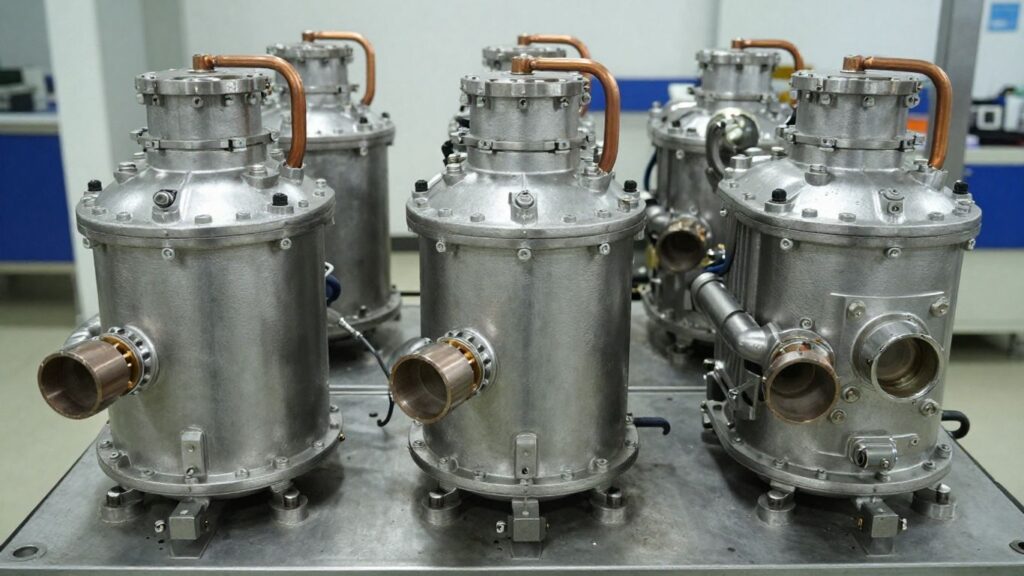
A hermetic compressor places the motor and compression mechanism inside a permanently sealed shell. The arrangement reduces external shaft-seal concerns and keeps the assembly compact, which is useful in household refrigerators and other self-contained appliances.
The trade-off is serviceability. If the motor burns out or an internal part fails, the shell cannot normally be opened and rebuilt in place. A technician must confirm the electrical and refrigeration diagnosis before replacement, because a sealed compressor is often a major part of the appliance repair cost.
Semi-hermetic compressors for serviceability
A semi-hermetic compressor uses a bolted housing that can be opened by a qualified technician. This makes it possible to inspect or replace selected internal components, depending on the model and damage. It can be a practical choice when the equipment is valuable enough to justify planned service.
The housing still has to maintain reliable seals after service. Correct torque, compatible gaskets, clean work practices, and proper evacuation all matter. Semi-hermetic construction offers access, but it does not remove the need for careful refrigeration work.
Open-drive compressors for industrial applications
An open-drive compressor uses a separate motor connected through a shaft, coupling, or belt arrangement. Since the motor sits outside the compressor housing, it can be serviced or replaced independently. This flexibility can be useful in industrial plants and larger systems with dedicated mechanical rooms.
The external shaft requires sealing against refrigerant leakage, and alignment becomes an installation concern. The motor, coupling, guards, and compressor also occupy more space than a sealed appliance package. Those requirements are reasonable for an industrial layout but rarely useful in a compact refrigerator.
Fixed-speed and variable-speed inverter compressors
A fixed-speed compressor runs at one designed speed and is controlled mainly by switching on and off. An inverter compressor can vary motor speed to follow the cooling demand more closely. That can reduce cycling, improve temperature stability, and lower energy use in some operating patterns, though actual results depend on controls, load, insulation, and ambient conditions.
Variable-speed systems also introduce electronics that must be compatible with the motor and installation. You should compare the rated operating range, sound levels, warranty, and replacement cost instead of assuming that inverter operation is always the best value. The technology is most useful when the refrigerator spends substantial time at partial load.
How to choose the right refrigerator compressor
Choosing a compressor starts with the refrigerator’s actual cooling requirement, not just the available space or advertised motor power. You need to match capacity, refrigerant, electrical supply, enclosure, and operating environment. A useful shopping decision guide can help you compare specifications and ownership costs without treating the lowest purchase price as the whole decision.
Matching compressor capacity to cooling demand
Estimate the heat entering the refrigerated space from the room, stored products, door openings, lighting, fans, and cabinet walls. Then account for pull-down periods, defrost cycles, and the desired temperature. The compressor must deliver enough capacity under the expected suction and condensing conditions, not merely under an ideal laboratory point.
An undersized unit may run almost continuously, while an oversized one may short-cycle. Both outcomes can waste energy and shorten component life. For a replacement, use the original compressor’s application data and have a technician verify compatibility rather than relying on dimensions alone.
Comparing energy efficiency and operating costs
Look beyond the compressor’s rated input. Annual energy use also depends on cabinet insulation, condenser cleanliness, controls, ambient temperature, door openings, and how often the compressor runs. A slightly higher purchase price may be sensible if the design remains efficient over the way you actually use the refrigerator.
Promo Deals helps shoppers find discounts and price information in one place, but you still need to compare the technical specification behind an offer. Promo Deals is most useful here as a way to organize deal-focused shopping information; the compressor’s capacity and operating data should decide whether the deal fits your appliance.
Evaluating noise, vibration, and available space
Measure the available mounting area and check clearance around the compressor and condenser. A design that fits physically may still transmit too much vibration through the cabinet or leave insufficient airflow for heat rejection. Rubber mounts, tubing placement, insulation, and fan condition can all affect perceived noise.
If the refrigerator is near a bedroom or living area, sound may matter almost as much as energy use. Ask for operating sound information where available, but remember that installation and cabinet resonance can change the result in your home.
Considering refrigerant compatibility and climate conditions
The replacement compressor must be approved for the refrigerant, oil, pressure range, voltage, frequency, and starting conditions of the system. Using a similar-looking compressor with a different refrigerant or lubricant can cause poor performance and mechanical damage.
Ambient temperature affects condensing pressure and cooling capacity. In a hot room, the compressor works harder and may need more condenser airflow. Your technician should check the system’s rated climate conditions and confirm that the selected compressor can operate safely at the expected maximum ambient temperature.
Balancing purchase price with maintenance needs
A low-cost compressor may appear attractive until you add labor, refrigerant recovery, evacuation, controls, transport, and future service. A serviceable design can be worth more in commercial equipment, while a sealed household unit may be judged against the cost and age of the entire refrigerator.
Use Promo Deals to locate relevant offers, then compare warranty terms, parts availability, installer expertise, and expected service life. The best value is the option that meets the cooling requirement and remains supportable, not automatically the cheapest listing.
Compressor problems, maintenance, and replacement
Compressor trouble can resemble several other refrigeration faults. A warm cabinet may result from a dirty condenser, failed fan, blocked airflow, thermostat problem, door leak, or refrigerant issue rather than a failed compressor. Good diagnosis prevents you from paying for a major replacement when a smaller repair would restore cooling.
Signs of compressor wear or failure
Watch for repeated clicking, humming without startup, unusually long run times, excessive shell temperature, tripped overload protection, or a refrigerator that cannot reach its set temperature. A compressor that runs continuously may be weak, but it may also be responding to a warm room, heavy loading, poor door sealing, or restricted condenser airflow.
A technician can compare suction and discharge pressures, electrical current, winding resistance, and start components. Those checks help distinguish an internal pumping problem from a failed relay, capacitor, control board, or wiring connection.
Causes of overheating, hard starting, and short cycling
Overheating can result from high condensing pressure, inadequate ventilation, incorrect charge, low voltage, or a motor working beyond its design point. Hard starting may follow from a defective start device, tight internal components, pressure that has not equalized, or an unsuitable replacement part.
Short cycling often comes from a control issue or a rapidly satisfied thermostat, but it can also signal incorrect sizing. Before blaming the compressor, check the sequence of events: how long it runs, what temperatures and pressures occur, and what causes it to stop.
Maintenance practices that protect compressor performance
You can reduce stress on the compressor with a few practical habits. They do not replace professional refrigeration service, but they help the system reject heat and maintain stable operating conditions.
- Keep condenser coils and ventilation openings clear of dust and stored items.
- Check door gaskets for gaps that allow warm, moist air into the cabinet.
- Leave enough space around the appliance for the manufacturer’s required airflow.
- Avoid repeated rapid restarts after unplugging, allowing pressure to equalize first.
These steps support the whole refrigeration system rather than the compressor alone. If the cabinet still runs hot or the compressor repeatedly trips, stop guessing and arrange a qualified inspection before continued operation causes more damage.
When repair makes sense and when replacement is better
Repair may make sense when the compressor is healthy but a relay, overload, capacitor, fan, control, or airflow problem has failed. It can also be reasonable when a newer appliance has a well-diagnosed compressor fault and the repair cost is proportionate to its remaining service life.
Replacement becomes harder to justify when the refrigerator is old, the cabinet seal or insulation is failing, parts are difficult to obtain, or the repair approaches the cost of a suitable new appliance. Refrigerant handling, brazing, evacuation, and charging should be performed by a qualified professional, since an incorrect installation can damage the new compressor.
Conclusion
The best compressor is the one that matches the refrigerator’s load, refrigerant, climate, space, noise expectations, and service plan. By separating compression method from enclosure and drive type, you can compare reciprocating, rotary, scroll, screw, and centrifugal designs more clearly and choose based on real operating conditions rather than labels alone.
Frequently Asked Questions
What is the main job of a refrigerator compressor?
It raises the pressure of low-pressure refrigerant vapor and circulates it through the refrigeration cycle so the system can absorb and reject heat.
Which compressor type is common in household refrigerators?
Hermetic reciprocating compressors are common, although rotary and variable-speed designs are also used in some appliances depending on capacity, noise, and efficiency requirements.
Are scroll compressors better than reciprocating compressors?
Neither is universally better. Scroll compressors can provide smooth operation and fewer reciprocating parts, while reciprocating compressors offer a familiar design and broad application range.
What does hermetic compressor mean?
A hermetic compressor has its motor and compression mechanism sealed inside one housing. This reduces external leakage points but usually prevents internal repair.
Why do compressors get hot?
Compression naturally raises refrigerant temperature, but excessive heat can result from poor condenser airflow, high ambient temperature, incorrect charge, electrical problems, or operation outside the rated range.
Can a larger compressor cool a refrigerator faster?
Not necessarily. An oversized compressor may short-cycle, create uneven temperatures, increase stress, and operate inefficiently. Capacity must match the system and its controls.
When should you replace a refrigerator instead of its compressor?
Replacement may be more sensible when the appliance is old, the cabinet or insulation is failing, parts are unavailable, or the complete repair cost is close to the price of a suitable new refrigerator.