What Is The Gas Used In Refrigerators? A Guide To Refrigerants, Safety, And Efficiency

Key Takeaways
Your refrigerator uses a refrigerant, not an ordinary fuel gas, to move heat out of the cabinet. The exact type depends on the appliance’s age, design, and label.
- Newer household refrigerators commonly use R-600a, or isobutane.
- Older models may contain R-134a, R-12, or other discontinued refrigerants.
- Refrigerant circulates through a sealed cycle of compression, condensation, expansion, and evaporation.
- Hydrocarbon refrigerants can be flammable, so the system should not be opened casually.
- The data plate or owner’s manual is the safest way to identify the refrigerant.
- What refrigerant gas does a refrigerator use?
- How refrigerants cool the inside of a refrigerator
- The most common refrigerator refrigerants explained
- Why refrigerator refrigerants have changed over time
- Are refrigerator refrigerants dangerous?
- How to identify the refrigerant in your refrigerator
- Refrigerant maintenance, leaks, and replacement
- Conclusion
- Frequently Asked Questions
What refrigerant gas does a refrigerator use?
When you ask, “What Is The Gas Used In Refrigerators?”, you are asking about the refrigerant that carries heat away from the food compartment. Modern household models often use R-600a, while many older appliances use R-134a or, in much older cases, R-12. The name on the label matters because each refrigerant works with a particular system design.
Common refrigerants in modern household refrigerators
R-600a is now widely used in newer domestic refrigerators because it has a low global warming potential and works effectively in small sealed systems. Some commercial and specialty equipment uses other options, including R-290, but you should never assume a replacement gas is suitable simply because it is available. Refrigerant choice is tied to pressures, tubing, compressor design, and safety requirements.
A useful refrigerant gas guide compares several refrigerant families, including hydrocarbons, fluorocarbons, carbon dioxide, and ammonia. That broader context helps explain why the same general cooling principle can use very different working fluids.
Why older refrigerators used CFCs and HCFCs
Older refrigerators commonly relied on CFCs such as R-12. Later equipment moved toward HCFCs and then HFCs as regulations responded to damage associated with ozone-depleting substances. You may still encounter these refrigerants in aging appliances, but they are not interchangeable with the gas specified for a modern refrigerator.
The age of an appliance can offer a clue, but it is not proof. A replacement compressor or a previous repair may also affect what is inside, which is why the label remains more reliable than a guess based on the model’s appearance.
How hydrocarbon refrigerants became more common
Hydrocarbons such as isobutane and propane attracted attention because they can provide useful refrigeration performance with relatively low global warming impact. R-600a, the refrigerant used in many newer household refrigerators, is a form of isobutane. Its environmental profile is favorable, but its flammability means the appliance must be engineered, charged, and serviced carefully.
That trade-off is part of modern appliance design. A small refrigerant charge inside a sealed system can be practical, but it does not make careless puncturing, brazing, or refilling safe.
Why the exact refrigerant depends on the appliance
The refrigerant is selected alongside the compressor, heat exchangers, expansion device, and operating temperature. A gas that performs well in a household refrigerator may be unsuitable for a freezer, display case, or larger commercial system. Even similar-looking appliances can therefore carry different refrigerant specifications.
For energy-conscious shopping, remember that the refrigerant is only one part of operating cost. You can also compare energy labels and compressor technology using practical AC efficiency comparisons, although air-conditioning ratings are not a substitute for a refrigerator’s own energy label.
How refrigerants cool the inside of a refrigerator
A refrigerator does not create cold from nowhere. It uses electricity to circulate refrigerant through a loop that absorbs heat inside the cabinet and releases it into the room. Once you understand that heat movement, the pipes and coils behind or beneath the appliance make much more sense.
The refrigeration cycle in simple terms
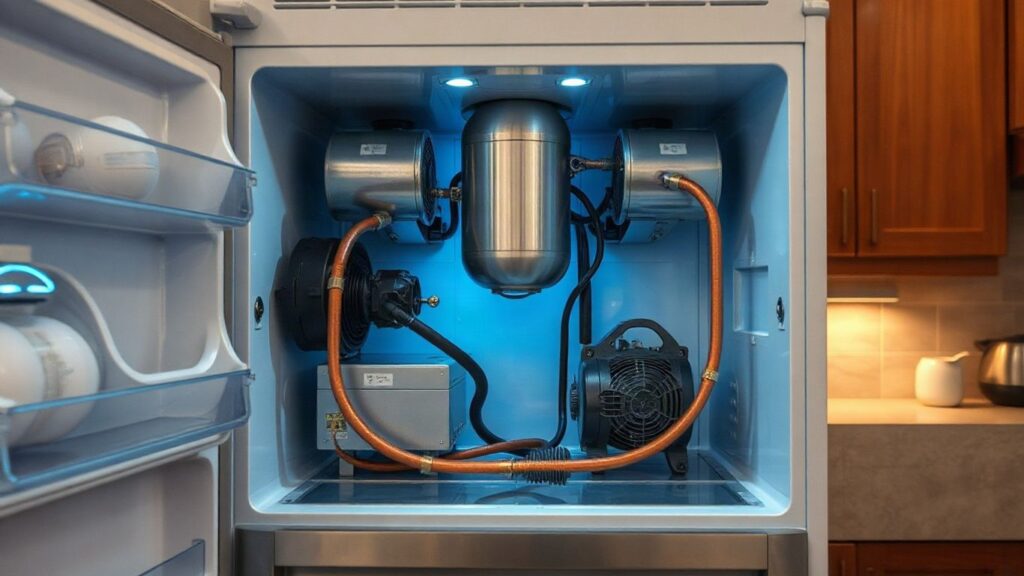
The cycle begins in the evaporator, where low-pressure refrigerant absorbs heat from the refrigerator compartment and changes toward a vapor. That vapor travels to the compressor, then moves through the condenser, where heat is released to the surrounding air. After pressure drops through the expansion device, the refrigerant returns cold enough to absorb more heat.
You can think of the refrigerant as a circulating heat carrier rather than as a substance that simply “makes cold.” The same basic vapor-compression idea is described in this overview of how refrigerants transfer heat.
How the compressor changes refrigerant pressure
The compressor draws in low-pressure vapor and squeezes it into a higher-pressure, higher-temperature vapor. This pressure change gives the refrigerant the conditions it needs to release heat through the condenser. The compressor motor is also one of the main electrical loads in the appliance.
If the compressor runs for long periods, that does not automatically mean the refrigerator has lost refrigerant. Dirty coils, poor door seals, blocked airflow, or a failing compressor can create similar symptoms.
The role of the condenser and evaporator coils
The evaporator coil sits where it can collect heat from the refrigerated space, while the condenser coil releases heat outside the cabinet. Fans may move air across these surfaces, depending on the design. Keeping airflow clear helps the system exchange heat as intended.
The condenser can feel warm during normal operation. That warmth is evidence that heat removed from the interior is being discharged into the room, not necessarily a sign of a fault.
How refrigerant changes between liquid and gas
Refrigerant absorbs and releases heat as it changes state. In the evaporator it boils at a low pressure, taking in heat as it becomes vapor; in the condenser it gives up heat and condenses back into a liquid at higher pressure. An expansion device then lowers the liquid’s pressure before it returns to the evaporator.
These phase changes are why refrigerant properties matter so much. Boiling point, pressure, and heat-transfer behavior must match the system, so topping up with a different substance is not a safe shortcut.
The most common refrigerator refrigerants explained
Refrigerant names can look cryptic, but they are simply standardized designations used to identify different working fluids. The most useful distinction for you is not memorizing every code; it is knowing which names commonly appear on household appliance labels and why they are not interchangeable.
R-600a and its use in newer refrigerators
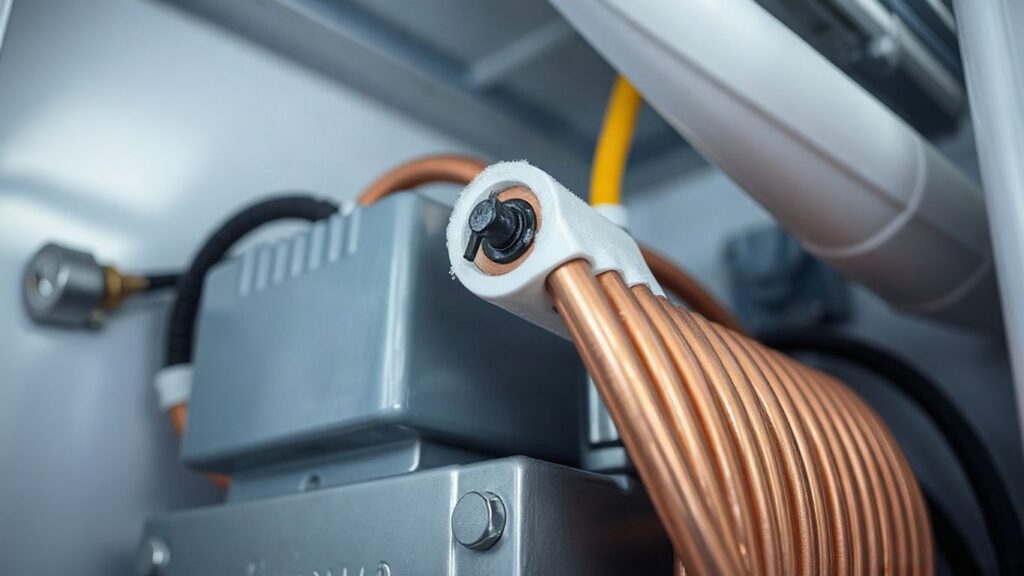
R-600a is isobutane, a hydrocarbon refrigerant widely found in newer household refrigerators. It has a low global warming potential and can support efficient operation in compact systems. Because it is flammable, appliances using it are designed around a small charge and specific safety controls.
If your refrigerator lists R-600a, use that exact information when arranging service. A technician needs the appliance’s specified refrigerant and charge, not merely a broadly similar gas.
R-134a in older household models
R-134a became common in many household refrigerators after CFC refrigerants were phased down. It does not deplete the ozone layer, but it has a higher global warming impact than some newer alternatives. Many older but still functioning refrigerators may therefore carry an R-134a label.
R-134a systems should be serviced according to their original specifications. Substituting R-600a without an appropriate redesign can create pressure, oil-compatibility, and safety problems.
R-12 and the history of CFC refrigerants
R-12 was used in older refrigerators and is a CFC refrigerant. CFCs were valued for useful refrigeration properties, but their effect on stratospheric ozone led to international controls and phaseouts. If you own a very old appliance, its label may identify R-12 even if the system no longer holds its original charge.
An old refrigerator with an R-12 system deserves particular care. A qualified technician can determine whether repair, approved recovery, or replacement is the sensible option.
R-290 and other alternatives in refrigeration
R-290 is propane used as a refrigerant in some refrigeration equipment, especially systems designed specifically for it. Other alternatives include carbon dioxide, ammonia, and newer low-global-warming refrigerant blends. Their suitability depends on equipment size, temperature range, pressure, toxicity, and flammability.
| Refrigerant | Common context | Main consideration |
|---|---|---|
| R-600a | Newer household refrigerators | Flammable hydrocarbon with low global warming potential |
| R-134a | Older household refrigerators | No ozone depletion, but higher global warming impact |
| R-12 | Very old refrigerators | CFC refrigerant subject to phaseout controls |
| R-290 | Some commercial refrigeration systems | Flammable propane-based refrigerant |
The table is a guide, not a substitution chart. The label on your appliance always takes priority over a general list of refrigerant types.
Why refrigerator refrigerants have changed over time
Refrigerant development has followed both engineering needs and environmental regulation. A substance can cool effectively yet create serious problems if it damages ozone or contributes substantially to climate change. Manufacturers have therefore moved through several refrigerant families rather than settling permanently on one gas.
The environmental impact of CFCs
CFCs such as R-12 can persist in the atmosphere and release chlorine that contributes to stratospheric ozone depletion. Since the ozone layer helps shield life from harmful ultraviolet radiation, controlling these chemicals became an international priority.
That history explains why an older appliance should not simply be refilled with its original refrigerant without considering recovery rules and approved service practices. Disposal and repair decisions affect more than the appliance itself.
How HCFCs affected the ozone layer
HCFCs were developed as transitional substances because they generally have less ozone-depleting impact than CFCs. They were not a permanent solution, however. Their remaining ozone impact and climate effects led to further phaseouts and restrictions.
If you inherit an older refrigerator, the refrigerant family can help indicate its environmental history, but the exact designation still needs to come from the data plate or service documentation.
The global warming potential of HFCs
HFCs such as R-134a do not deplete stratospheric ozone, but some have significant global warming potential. That concern encouraged research into refrigerants with lower climate impact, including hydrocarbons and other alternatives.
Global warming potential is only one selection factor. Pressure, efficiency, toxicity, flammability, equipment cost, and service requirements all matter when an appliance is designed.
Why natural refrigerants are gaining attention
Natural refrigerants include hydrocarbons, carbon dioxide, and ammonia. They occur in nature and can have lower climate impacts than many older synthetic refrigerants, but that does not mean every natural option belongs in a household refrigerator. Safety classification and system design remain essential.
The shift is best understood as a balancing act: manufacturers seek reliable cooling and manageable energy use while reducing environmental harm. The right refrigerant is the one engineered for the particular system.
Are refrigerator refrigerants dangerous?
A sealed refrigerator system is designed to contain a small amount of refrigerant during normal use. That does not make refrigerants harmless, though. Some can displace oxygen in a confined space, some may irritate you, and hydrocarbon refrigerants can ignite under the right conditions.
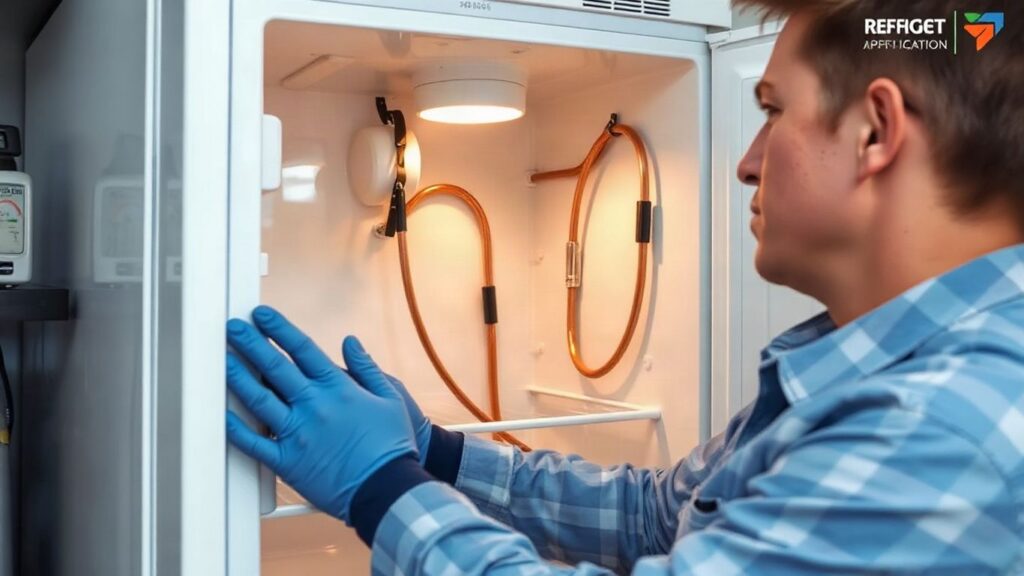
Flammability risks of hydrocarbon refrigerants
R-600a and R-290 are flammable hydrocarbons. Their use in refrigeration depends on controlled charge sizes, sealed components, suitable electrical parts, and tested appliance designs. You should never drill, cut, weld, or apply an open flame near refrigeration tubing unless the system has been properly handled by a qualified professional.
A small charge still deserves respect. The risk is not a reason to panic during ordinary use, but it is a reason to avoid improvised repairs.
Toxicity and exposure concerns
Refrigerants vary in toxicity, but exposure can still be dangerous, especially in a poorly ventilated room. A leak may cause dizziness, breathing discomfort, or irritation, while contact with escaping liquid can cause cold burns or frostbite-like injury.
If you feel unwell around a damaged appliance, move to fresh air and seek appropriate medical or emergency guidance. Do not deliberately sniff a suspected refrigerant leak to identify it.
Why refrigerant systems are sealed
A sealed system prevents the refrigerant from escaping and keeps moisture and contaminants out of the circuit. The tubing, compressor, joints, and heat exchangers are designed to work as one closed loop. Under normal conditions, the refrigerant should not be consumed or regularly topped up.
That is why a refrigerator needing repeated recharging likely has an underlying leak or another fault. Adding refrigerant without finding the cause only postpones the problem.
What to do if a refrigerator has a suspected leak
If you suspect a leak, unplug the appliance if you can do so safely, ventilate the area, and keep flames and sparks away. Avoid touching damaged tubing or attempting to seal it with household materials. Arrange an inspection by a qualified refrigeration technician.
A practical response usually follows a few basic steps:
- Keep people away from visibly damaged tubing.
- Ventilate the room without creating sparks.
- Avoid flames, smoking, and improvised tools.
- Check the appliance label before discussing service.
These steps reduce immediate risk, but they do not diagnose the leak. Professional recovery, repair, pressure testing, and recharging require the correct equipment and procedures.
How to identify the refrigerant in your refrigerator
You usually do not need to open the appliance to identify its refrigerant. Manufacturers place the relevant information on a rating plate, service label, or technical document. Looking in the right places is safer and more accurate than trying to infer the gas from cooling performance.
Finding the data plate or manufacturer label
Start by checking the rear, side, or lower portion of the refrigerator cabinet. Some labels are inside the fresh-food compartment, near the door frame, or behind a removable kick plate. Use a flashlight and take a clear photograph if the lettering is difficult to read.
The label may list the refrigerant designation, charge amount, voltage, model number, and serial number together. Do not remove panels simply to search for it.
Reading the refrigerant type and charge information
Look for a notation such as “Refrigerant,” “Refrig,” or “Charge,” followed by a code like R-600a or R-134a and a mass in grams. The charge amount is not a refill recommendation for a different gas; it is part of the appliance’s specific service information.
Record the refrigerant type and charge exactly as printed. Even a small difference in the code can indicate a different substance or blend.
Checking the owner’s manual and model number
If the physical label is missing or worn, search the owner’s manual using the complete model number. Manufacturer service documents may also identify the refrigerant, but make sure the document matches the exact appliance revision and market.
The model number is also useful when you contact a repair company. It helps the technician prepare for the correct components and service procedure before arriving.
Why the refrigerant should not be identified by appearance
Refrigerants are not reliably identified by color, smell, frost pattern, or the temperature of a pipe. Many are clear, and normal system behavior can vary with room temperature, load, airflow, and control settings. A visual guess can therefore lead to a dangerous servicing error.
Use the data plate or qualified service documentation instead. If neither is available, let a technician identify the system with appropriate tools.
Refrigerant maintenance, leaks, and replacement
Most refrigerators do not need routine refrigerant maintenance in the way a vehicle needs fuel or an appliance needs a filter change. The system is sealed, so a refrigerant shortage usually points to a leak or component failure. Your regular care is more about keeping airflow clear, checking door seals, and noticing changes early.
Signs that a refrigerator may have a refrigerant problem
A cooling problem can appear as warm food, uneven temperatures, frost in an unusual location, or a compressor that runs for unusually long periods. You may also notice an oily residue near a joint, since refrigerant oil can travel with a leak. None of these signs proves that refrigerant is the cause.
Before calling for service, check whether the door closes properly, vents are blocked, and the condenser area is heavily dusty. Simple airflow problems can look surprisingly similar to a sealed-system fault.
Why low cooling does not always mean low refrigerant
A failed fan, defective thermostat, blocked evaporator, damaged gasket, or weak compressor can all reduce cooling. Heavy frost can also restrict airflow and make the cabinet warm even though the refrigerant charge is correct.
This distinction matters because refrigerant should not be added as a guess. A proper diagnosis tests the system rather than treating every temperature complaint as a leak.
Why only qualified technicians should service the system
Servicing involves refrigerant recovery, leak detection, evacuation, pressure checks, and accurate charging. The technician also needs to understand the refrigerant’s flammability and the appliance’s electrical and mechanical design. Opening the circuit without the right equipment can release refrigerant or introduce moisture.
You can help by giving the technician the model number, label information, symptoms, and any history of previous repairs. That information makes the inspection more efficient without putting you in the position of handling the refrigerant.
How proper disposal protects people and the environment
When a refrigerator is discarded, its refrigerant should be recovered rather than vented. Recycling and disposal providers can also handle compressors, oils, insulation, and other components through appropriate channels. Leaving an old appliance beside ordinary trash may create hazards for workers and the environment.
Ask the retailer, local waste authority, or certified appliance recycler how the unit will be handled. Proper disposal closes the loop on both safety and environmental responsibility.
Conclusion
The gas in your refrigerator is a carefully selected refrigerant that moves heat through a sealed cycle. R-600a is common in newer household models, while R-134a and R-12 may appear in older appliances. To identify yours safely, read the data plate or manual and leave leaks, replacement, and disposal to a qualified technician.
Frequently Asked Questions
Is refrigerator gas the same as cooking gas?
No. Refrigerator gas is a refrigerant designed to circulate through a cooling system, while cooking gas is a fuel. Some refrigerants, such as R-600a and R-290, are hydrocarbons and can be flammable, but they are not intended for household cooking equipment.
Do refrigerators use oxygen to make cold?
No. A refrigerator does not consume oxygen to cool food. Its refrigerant circulates through a closed loop, absorbing heat inside the cabinet and releasing it outside.
Can you smell a refrigerant leak?
Many refrigerants have little or no noticeable odor, so smell is not a dependable detection method. A qualified technician uses appropriate leak-detection equipment rather than relying on your senses.
How long does refrigerator refrigerant last?
Refrigerant can last for the life of the appliance because it is not normally used up. If the charge becomes low, the system may have a leak or another sealed-system problem that needs diagnosis.
Is R-600a safe in a home refrigerator?
R-600a can be used safely in a properly designed and intact refrigerator. It is flammable, however, so you should not puncture tubing or attempt an unqualified repair.
Can you replace R-134a with R-600a?
Not as a simple refill. The refrigerant, compressor, oil, charge, tubing, and safety design must match, so any conversion would require a qualified assessment and appropriate equipment.
Should you repair or replace an old refrigerator?
Consider the appliance’s age, energy use, repair cost, refrigerant type, and condition. A technician can help you compare a sealed-system repair with replacement, especially if the model uses a discontinued refrigerant.